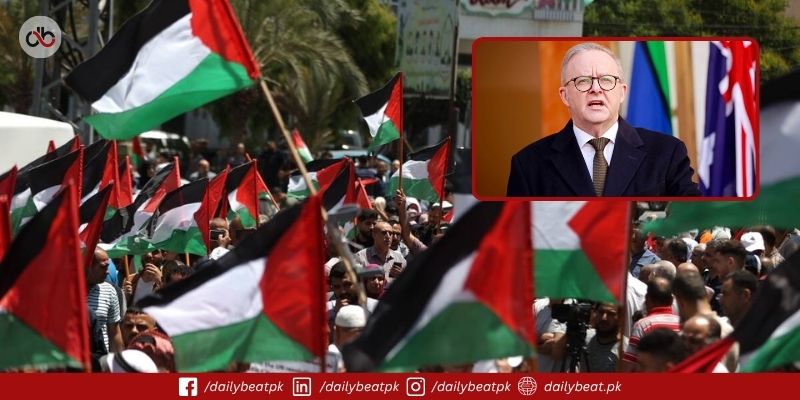
Prime Minister Anthony Albanese announced on Monday that Australia will formally recognise a Palestinian state at the upcoming United Nations General Assembly in September.
The move marks a significant shift in Australia’s foreign policy and aligns the country with other Western nations that have recently supported Palestinian statehood.
Speaking to reporters, Prime Minister Albanese said that permanent peace in the Middle East could only be achieved through a lasting agreement between Israel and the Palestinians.
“Until Israeli and Palestinian statehood is permanent, peace can only be temporary,” he stated.
He confirmed that Australia “will recognise the right of the Palestinian people to a state of their own,” adding that this decision is part of the country’s commitment to supporting a peaceful two-state solution.
Albanese also revealed that the Palestinian Authority had given clear assurances about the governance of a future state. According to him, there would be “no role for the terrorists of Hamas in any future Palestinian state.”
“This is an important step to ensure that peace efforts are based on security, stability, and mutual recognition,” he said.
Australia’s announcement comes at a time when international support for Palestinian statehood is gaining momentum.
Several countries, including France, Britain, and Canada, have recently expressed their readiness to recognise Palestine as an independent state.
These moves follow ongoing conflict in the region, which escalated after Israel launched military operations in Gaza nearly two years ago in response to Hamas attacks. The violence has claimed thousands of lives and left diplomatic efforts strained.
Prime Minister Albanese described the decision as a chance to contribute positively to a long-standing global issue.
“There is a moment of opportunity here, and Australia will work with the international community to seize it,” he said.
He stressed that the recognition is not just symbolic but also part of a broader diplomatic effort to push for renewed peace talks and an end to hostilities.
While official international reactions are still unfolding, the decision is expected to be welcomed by countries supporting a two-state solution.
At the same time, it may draw criticism from those who believe such recognition should come only after a negotiated peace settlement between the two sides.
Political analysts say the move could boost Australia’s standing in the international community as a nation willing to take a clear position on one of the most complex geopolitical disputes.
However, it may also lead to diplomatic challenges with nations that oppose Palestinian recognition outside a final peace agreement.
Despite the announcement, significant challenges remain. The Israeli–Palestinian conflict has endured for decades, with multiple failed peace processes and deep mistrust on both sides.
Analysts note that recognition by Australia and other countries is unlikely to immediately resolve the conflict but could add diplomatic pressure for renewed negotiations.
The UN General Assembly in September will serve as a key platform for Australia to formalise its recognition. It is also expected to be an opportunity for world leaders to debate possible pathways to a lasting peace agreement.
In a significant policy change, Israel has approved a plan for the takeover of Gaza City.